
The REDHy project has successfully achieved Milestone 8 (MS8): Model of Optimal Electrode Design, marking an important step towards optimising the performance of the REDHy electrolysis system. This milestone represents another important step in REDHy’s efforts to develop a more efficient and sustainable approach to hydrogen production.
As part of Work Package 4 (WP4), the project team has developed a 3D digital twin of the REDHy system using COMSOL Multiphysics®.
It allows evaluating the influence of the porous electrode structure on the current density of the REDHy system. It permits also to evaluate the ideal parameters (solubility, charge transfer kinetic, flow velocity, etc.) that will allow achieving the forseen performances.
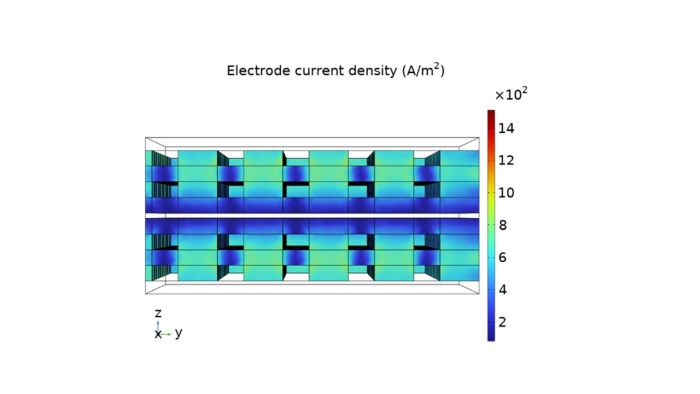
A 3D model is developed for a printed electrode in a symmetric redox flow battery configuration. The results clearly showed heterogeneity in the distribution of current, redox concentration and flow velocity. This points out the necessity of optimizing the electrode geometry, which will be realized by experiments. For achieving the project target current density 1.5 A/cm2, the mesh of the model must be fine enough to probe the variation of variables near the electrode surface, especially at areas with sharp angles of geometry (Fig 1. Reports the expected current density distribution between the current collector and the membrane, reflecting the progressive consumption of redox species by the electrochemical reaction).
Figure 1 Current density at the electrode surface.
Result/ What will it be used for: This digital twin provides the REDHy consortium with a powerful tool for prioritising the parameters that have the greatest influence on system performance. The modelling results will support the experimental optimisation of the electrode geometry and help guide the development of high-performance 3D-printed electrodes.
These results highlight the importance of carefully optimising the electrode geometry. In particular, the model can be used to investigate how parameters such as solubility, charge-transfer kinetics and flow velocity affect system performance. Guiding the next stage of electrode optimization.
Impact: This milestone allows to prioritize the most critical parameters to be optimized within the consortium for reaching the highest possible performances. By combining multiphysics modelling with experimental validation, the project aims to identify an electrode design that can deliver high current densities while maintaining efficient mass transport and flow characteristics.
Milestone 8 was led by CNRS and was achieved in September 2026, in connection with Deliverable 4.2 – Modelling of the REDHy system.