
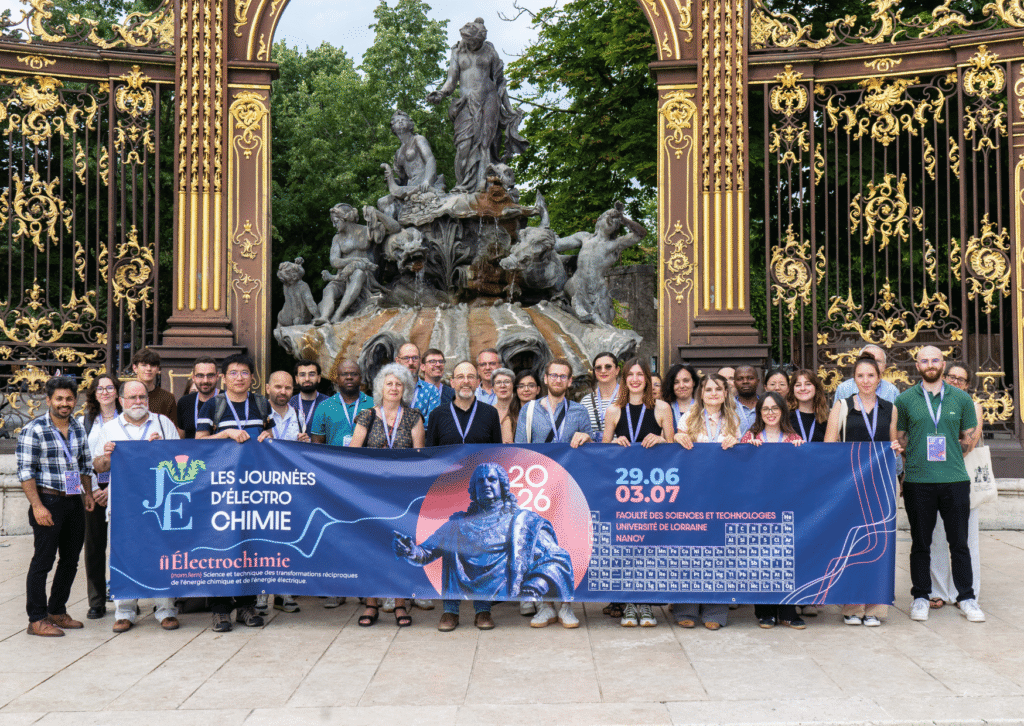
Les Journées d’Électrochimie, a biennial scientific congress organized under the auspices of the Electrochemistry Division of the French Chemical Society (Société Chimique de France), was held in Nancy from 29 June to 3 July by the CNRS partner of the REDHy consortium.
This congress brings together the electrochemistry community every two years to discuss major advances in the field and to foster scientific exchanges between researchers, students, and industry partners. The event provides a forum for presenting recent developments, sharing expertise, and strengthening collaborations across the broad spectrum of electrochemical research.
The bilingual congress allows participants to present their work either in French, the language of the congress, or in English.
Electrochemistry plays a central role in addressing major societal challenges related to energy, health, and the environment. The scientific programme covered seven main research areas:
- Photo- and spectro-electrochemistry
- Molecular electrochemistry, electrosynthesis, and electrocatalysis
- Electroanalysis, sensors, and lab-on-a-chip technologies
- Energy conversion and storage: batteries, supercapacitors, electrolyzers, and fuel cells
- Bioelectrochemistry, biosensors, and biobatteries
- Electrochemical engineering: electrolytes, recycling, and electrometallurgical processes
- Corrosion, coatings, and surface treatments
The organization of the congress was led by Mathieu Etienne (LCPME, CNRS and University of Lorraine), Chair of the Organizing Committee, together with the organizing team.
Through their involvement in Les Journées d’Électrochimie, CNRS and LCPME contributed to bringing together the electrochemistry community and highlighting the importance of electrochemical research in the development of sustainable technologies and innovative solutions for future challenges.
The REDHy project was present in the scientific contribution from Wei Guo and Mariela Brites Helu describing electroanalytical methods developed for screening molecules, catalysts and formulations for the REDHy system.